<TODO: UNDER CONSTRUCTION, this post need more work from me>
Fasces: An assemblage of wooden rods, tied together around an axe.
Derived from the word “fasces”, Fascism places emphasis on its strength through unity. It is also one of, if not the most, destructive political ideologies ever created by mankind. This is known; it is fact. As true as the sun rising in the morning and setting in the evening.
“Fascism is a genus of political ideology whose mythic core in its various permutations is a palingenetic* form of populist ultra-nationalism.” ~ Roger Griffin
*Palingenetic: “Rebirth of a Nation”, Revolution
The above quote is generally accepted to be the “closest” historians have gotten to accurately describing what Fascism actually is, though it is itself not without its criticisms. It is a simplification that functionally isn’t very useful and doesn’t make it any simpler to identify a fascist movement. In fact, Mussolini’s own analogy of the fasces isn’t a good description of fascism, as it applies to a far broader range of political systems. In fact, many could argue that the point of any political system is to create strength through unity. We can’t rely on defining Fascism by its various incarnations either, in the same way we cannot define democracy as Germany’s Bundestag or the USA’s Congressional System.
Fundamentally, we don’t know - or rather cannot state clearly - what it is.
I grew up under the impression that we understood “what” fascism was. We paid a pretty heavy price for it back in WW2, so it would stand to reason that we’d try to label what it was to better identify it in the future, before it could grow out of hand.
Yet, it remains one of the most nebulous and poorly understood political ideologies. Among historians, the exact definition of the term varies heavily. In fact, its poor usage over the years as a word to sensationalize headlines or to attack opposing political perspectives has only helped cloud its true nature, and essentially discredited its significance - making it harder to communicate its immense danger to society and personal liberty.
This is almost to be expected due to the variant nature of Fascism, which unlike many other political movements, heavily relies on the backing of the nations cultural identity to stand up. Every country has its own history and claims. Furthermore, even proponents of Fascism who claim to be anti-capitalist, anti-marxist, anti-democracy, anti-conservative, anti-liberal, anti-whatever, tend to contradict their own claims anyway, further muddying the waters as to WTF it even is.
We can’t even rely on the historical parallels of events leading up to full Fascist seizure of political power because at every stage the significance of an event heavily relies on the response of the world around it, which heavily varies with the culture of the nation and the time period that it happens in.
In my opinion (and I’m not a historian nor am I qualified to make scientific claims so take this with a grain of salt): It makes sense to view Fascism less like a political ideology on the same league as capitalist democracy and marxist socialism, but rather as a set of guidelines used to yield a countries own national identity as a tool for power.
Fascism ultimately promises not a better life than the one current, but rather an entirely different culture and nation which it claims is capable of greater feats than opposing ideologies. While not typically laid out directly, historically this typically leads to the use of authoritarian methods to enforce said unity, in the same way communism leads to an authoritarian state despite never requiring it.
Properties
It would be a lie however to claim that we were completely in the dark, as we do have an understanding of common “properties” shared between fascists:
- Fascists typically view themselves not as far-right, but rather as proponents of a third way or revolutionary alternative.
- They reject liberalist capitalism as they believe it leaves the nation too divided and individualistic.
- They reject Marxist socialism as they believe it leaves the nation divided by replacing national unity with class warfare.
- Fascists prioritize national identity above all else.
- Everyone under fascism is expected not to work for themselves, or for the betterment of their class, but for the betterment of their nation.
- They are typically proponents of a corporatist economic system, which organizes society around “corporations”, such as one body to represent workers, and another to represent the employers, with the “nation” acting as a guiding body between them.
- This is different from communism, where the distinction between the two groups entirely disapears.
- Fascists are not opposed to violence and typically believe in a heavily Darwinian system, where only the “strong” cultures and systems may survive to reap the rewards.
- Emphasis on discipline, strict organisational hierarchy and most of all, “duty”.
Sensationalization and the Media
Since WW2, the world as a whole has tended to view Nazism as synonymous with Fascism, rather than seeing it as the most extreme outcome. Therefore, they instinctively reject any notion of comparison between modern political movements and Fascism. Here’s Piers Morgan discrediting a very real concern about Trump’s political ideology by simply saying he hasn’t committed genocide yet, which is pretty much like me saying that the forest is fine because the leaking oil barrel I placed right in the centre hasn’t caught fire… yet.
In fact, it’s not hard to reason that the intensity of Fascism has been blown so far out of proportion that modern audiences likely wouldn’t be concerned with Hitler’s rise to power until he starts killing millions of Jews, Slavs, Gays, and other marginalised peoples. At which point, of course, it’s far too late.
The Aesthetics of Fascism
If one thing can be said about Fascism, it’s that its aesthetics are possibly the single most integral component to its spread, far more so than with other ideologies. Its obsession with visual iconography can be labelled as downright obsessive.
This is because Fascism’s promise is ultimately an empty one, and therefore, to justify its own existence, it needs, for lack of a better term, a forced identity mixed with heritage to back it. Of course, this heritage doesn’t need to be “real” at all. In fact, the Germans notoriously stole a ton of their rituals from popular media - the most famous of which is their Roman salute, which claimed to be used by the Romans as a sign of commitment and allegiance, despite having zero historical backing and it’s only source being an old film that made it up. The same can be said for their use of Nordic-like typography in propaganda, designed to imitate the supposed heritage of the mythical Vikings of old.
Fascism constantly bombards its population with nationalist marches, events, ceremonies, and anything else that can build, maintain, and propagate a mystique around their culture. It transforms the movement from being purely political into something spiritual, something supposedly deeply embedded within every person in the nation.
Once this is fully achieved, the nation has the capability to convince itself of almost anything: the Anschluss of Austria, the annexation of Czechoslovakia, etc…
Fascist architecture especially was a prime example of this, being designed to incite an emotional response not unlike the buildings of old religious institutions. The scale, symmetry, monuments, and imposing structures all served to make the ideology feel larger than the individual.
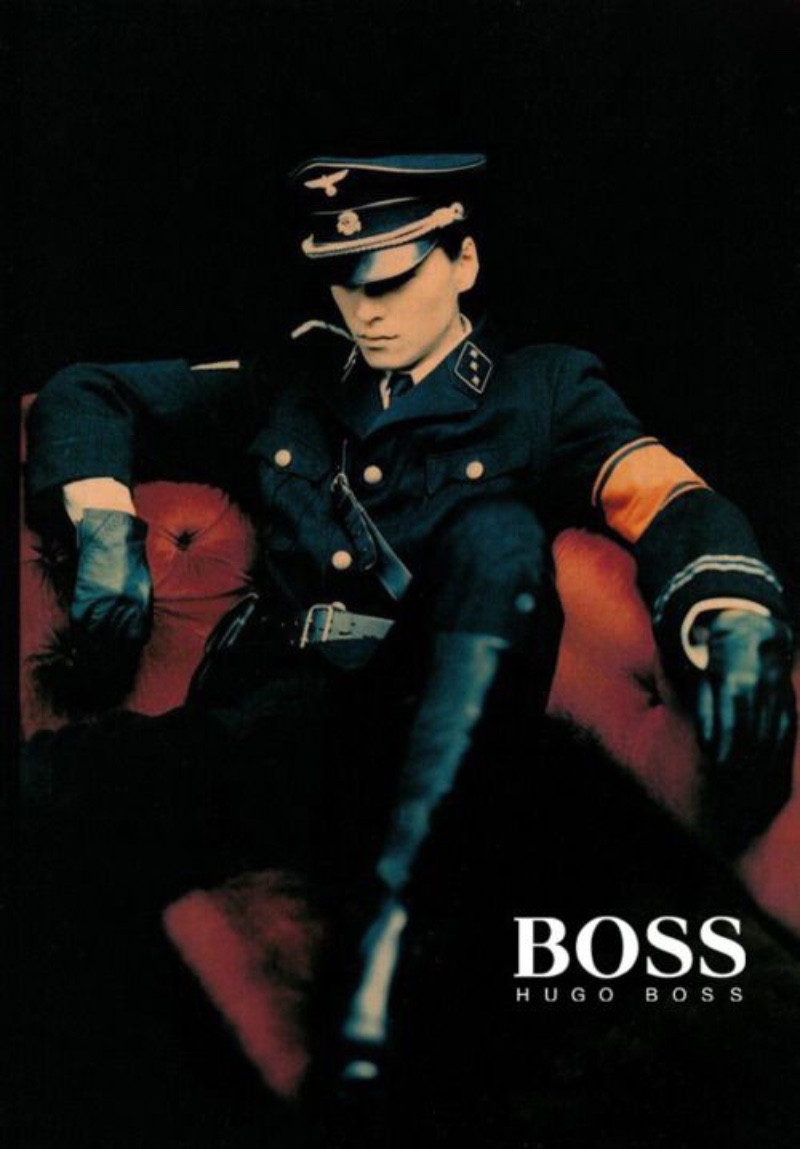
It’s no coincidence that the German SS uniform looked the way that it did. It was designed to project an image of power, discipline, mystique, and exclusivity; to incentivise people to join the SS and make membership feel like becoming part of something greater than themselves. It became a symbol of an almost ritualistic sacrifice for the nation.
Conditions
The problem with this all is that these ideas don’t seem like something anyone would want to be a part of. It doesn’t seem like a good society at all. So how did these organisations form? How did they seize power?
Well, many factors. One of which, possibly the most influential, was the Great War, otherwise known as WW1. The Great War was a conflict of a scale not yet seen ever in the history of humanity, with a casualty count to match. An entire generation of people was slaughtered and lost, and particularly in Europe it created a common sense among people that the image of a civilised, sophisticated and most importantly: stable, Europe was fading, if it was present at all. Such political instability created a perfect breeding ground for new ideologies which disagreed heavily on how to best reign the “new” world.
Remember, a global order that was by-in-large constant for centuries had just been completely annihilated in the span of a couple years. There’s a reason so many revolutions happened in this period, notably Communist thinking was beginning to take off in Russia. In the wreckage of the war, we were left with the American liberalists and Soviet communists, neither of which were fully succeeding either. The Americans were failing to keep peace through treaties, and the communists under Lenin were failing to globalise the revolution, and stuck to govern Russia. This effectively left a power vaccuum, for a third idea.
TODO
Fin.
With the rise of the far-right across the world today, particularly in America and Europe, I feel that understanding Fascism is something all citizens should strive to do.
Thanks for reading. I want to clarify that this post is mostly just notes I’ve made from reading and watching some stuff on Fascism.